
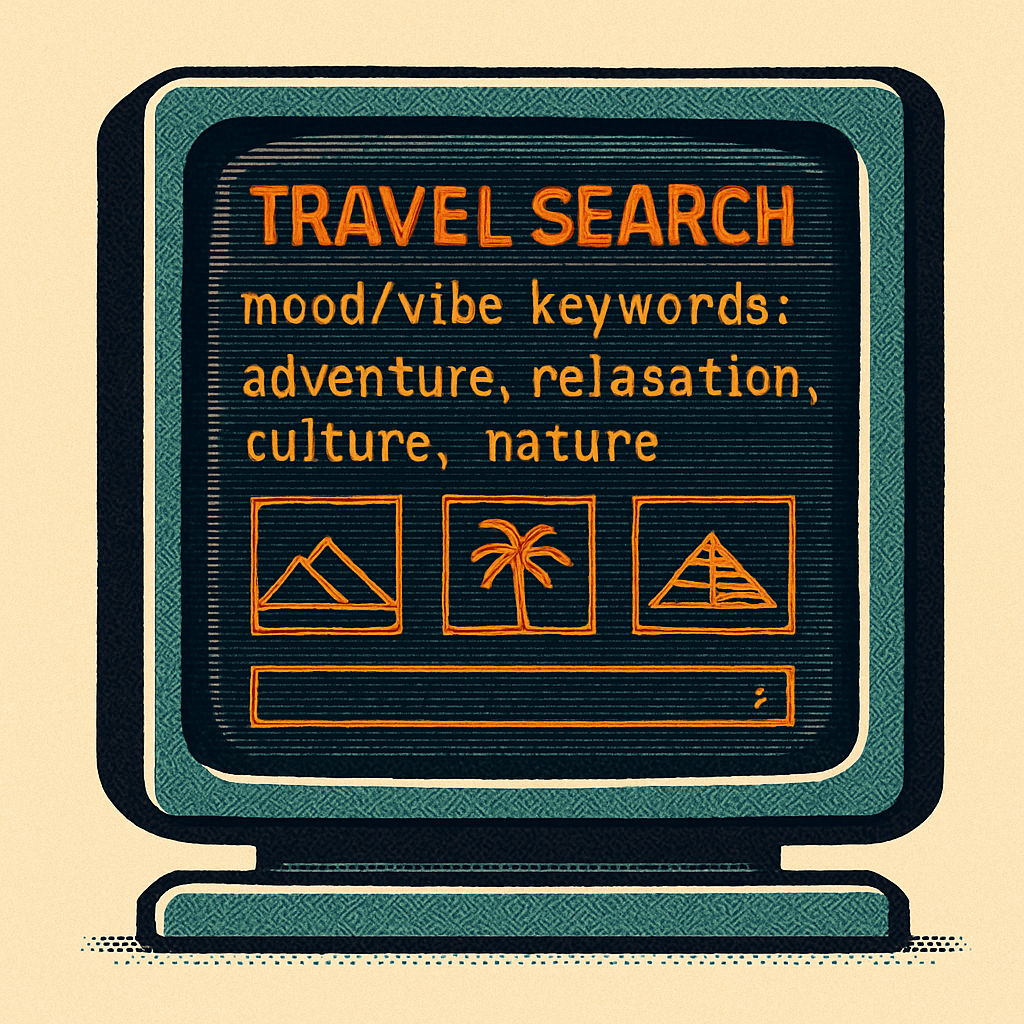
There's a new way travelers are searching for trips — and most booking engines aren't built for it.
It doesn't start with a destination. It doesn't start with dates. It starts with a feeling.
"Somewhere warm, adults-only, near the ocean, great local food, end of June."
No dropdown. No calendar. No filter panel. Just a description of an experience — typed into a search bar, a chatbot, or a conversational AI. Welcome to #VibeBooking.
It's the most significant shift in travel search since the OTAs replaced the travel agent. And if your booking engine still starts with "Where are you going?", you're already behind.
What Is #VibeBooking?
#VibeBooking is the shift from form-based travel search — where travelers enter a fixed destination, dates, and guest count — to intent-driven search, where travelers describe an experience, a feeling, or a lifestyle and expect AI to match them to the right property.
Instead of a date picker and a dropdown, a #VibeBooking search looks like a conversation: open-ended, descriptive, and impossible for a traditional booking widget to process.
From Filter to Feeling: How Travelers Actually Search in 2026
Picture the old way. A traveler goes to a hotel website or OTA, types in a city, picks their dates, selects how many guests, and hits search. The system returns a grid of rooms sorted by price. The traveler scrolls. They compare. They bounce.
Now picture how the same traveler searches today.
They open a conversational AI — maybe it's AtlasIQ's booking layer embedded on your site, maybe it's ChatGPT, maybe it's a travel agent powered by a language model — and they type:
"Family safari, Kruger, end of May, two rooms, kids under 10."
Or:
"Boutique eco lodge, Costa Rica, June, adults only, pool, under $300 a night."
Or simply:
"Somewhere romantic and off the beaten path for our 10th anniversary."
These are #VibeBooking searches. They're not keyword queries. They're not filter combinations. They're intent signals — and the operators who've built booking layers that can understand and respond to them are the ones converting guests that everyone else is sending to Booking.com.
The Generational Data Behind the Shift
This isn't a niche trend. The data makes it hard to ignore.
10% of Gen Z travelers start their trip search with no destination in mind — compared to just 3% of Baby Boomers. They don't think in itineraries. They think in experiences, aesthetics, and feelings.
And it's not just Gen Z. Travelers using conversational AI are 10x more likely to start open-ended — with no fixed destination, no set dates, just a sense of what they want. That's not a marginal difference. That's a structural change in how demand enters the travel market.
89% of consumers say they want AI assistance during travel planning. 83% have already used or are actively interested in AI tools to plan their trips.
Meanwhile, 37% of travelers now use AI embedded in booking platforms to plan and book — a figure that's accelerating. These aren't early adopters anymore. This is the mainstream.
The generational shift is real, it's measurable, and it's arriving faster than most operators expected.
Why the Booking Form Was Never the Right Interface
The traditional booking widget was designed for a different era. It assumes the traveler knows where they want to go, when they want to arrive, and how many guests are coming — before they've even started browsing.
That's not how travel decisions work.
Most trips start with inspiration, not information. A traveler sees a friend's Instagram story in a place that looks incredible. They read an article about a type of experience they've never tried. They get three weeks off work and realise they want to go somewhere — they just don't know where yet.
The booking form says: "Tell me the logistics first."
The traveler says: "I don't have the logistics yet. I have a vibe."
That friction is where you lose them. They leave your site and go to an OTA, or a travel blog, or now — a conversational AI platform. And if that AI doesn't route back to your direct booking engine, you've just paid the OTA's commission on a guest who could have booked with you directly.
Static booking widgets don't miss some guests. They miss entire categories of guests.
What a #VibeBooking Search Looks Like in Practice
Here's what the shift looks like side by side.
| Form-Based Booking | #VibeBooking |
|---|---|
| Destination: [Cape Town] | "Somewhere on the coast, warm, boutique" |
| Check-in: [June 14] | "Late June, flexible by a few days" |
| Guests: 2 adults | "Just the two of us, anniversary trip" |
| Filter: pool, spa | "Quiet, romantic, great food on site" |
| [SEARCH] → 247 results | → One perfect match, available, confirmed |
In the form-based world, the traveler does all the work. They filter, compare, and decide.
In the #VibeBooking world, the AI does the work. The traveler describes. The system interprets. The result appears.
The properties that show up in that result? They're not the ones with the best marketing budgets. They're the ones whose booking layer can parse natural language, match it to real inventory, and return a confident answer — instantly.
How AI Booking Engines Convert Vibe Searches Into Confirmed Bookings
The gap between a #VibeBooking search and a confirmed direct booking comes down to three capabilities:
1. Natural language understanding
The booking layer needs to parse intent, not keywords. "Adults-only," "kids-friendly," "off the beaten path," and "near the coast" are not tags in a database. They're intent signals — and the system needs to map them to real property attributes in real time.
Traditional booking engines can't do this. They look for keyword matches against a schema. A conversational AI booking engine understands what the guest means and surfaces what they're actually looking for.
2. Real-time availability
A #VibeBooking search is useless if the result is stale. Guests expect to go from "I found the perfect place" to "it's booked" in the same conversation. If your availability data is cached, static, or updated nightly, the AI either returns incorrect results or skips you entirely.
The booking layer needs live inventory. Always.
3. Frictionless booking in the same conversation
The moment a traveler has to leave a conversational search to fill in a separate form, you've broken the experience. The best AI booking engines convert within the conversation — from the first vague query to a confirmed booking, without a handoff to a traditional interface.
This is what AtlasIQ is built for. A conversational AI that sits on your website, understands natural language queries, knows your real availability, and books guests directly — no OTA, no commission, no friction.
What Operators Need to Do Right Now
If you're a hotel owner, lodge manager, or tour operator, here's how to position your property for the #VibeBooking era:
1. Add rich attribute tagging to your property listings
Map your property to the language guests actually use. "Kids-friendly" isn't just a checkbox — it means "playground, shallow pool, babysitting, kids' menu." The more accurately your property is described in intent vocabulary, the more often AI surfaces it for the right searches.
2. Make your availability queryable in real time
Static calendars and nightly-refresh systems won't cut it. Your availability data needs to be accessible via API so AI booking tools can query it live at the moment a guest asks.
3. Replace your booking widget with a conversational booking layer
If your website still starts with a destination dropdown and a date picker, you're optimised for 2015 not 2026. The upgrade isn't a redesign — it's adding an AI layer that handles the conversation before the booking form ever appears.
4. Optimise your content for AI search (GEO)
AI platforms like ChatGPT and Gemini are now the starting point for millions of travel searches. If your property isn't showing up in those answers, you're invisible to a growing share of the market. Structured content, schema markup, and authority signals are the foundation of appearing in AI-generated travel recommendations.
5. Train your AI on your unique experiences
#VibeBooking searches work best when the AI knows your property deeply. "Romantic getaway" only maps correctly if your AI knows you have a candlelit terrace, an in-room firepit, and a couples' spa treatment you can book directly. The richer the training, the more accurately the AI matches — and converts.
#VibeBooking Is Already Happening
You don't need to wait for this shift. It's here.
The travelers typing open-ended queries into ChatGPT, asking conversational AI assistants for travel recommendations, and expecting instant, personalised results — they're not a future cohort. They're booking trips right now.
The operators converting them are the ones who've built (or connected to) an AI booking layer that speaks their language.
The operators losing them are the ones still pointing guests at a calendar widget and hoping they figure it out.
AtlasIQ replaces your static booking widget with a conversational AI that understands vibe, knows your inventory, and converts enquiries into direct bookings — without a form, without an OTA, and without friction.
The era of form-based booking is ending. #VibeBooking is what comes next.
Ready to convert #VibeBooking searches into direct bookings?
See how AtlasIQ can help you capture travelers who search by vibe, not by destination.
Get StartedFrequently Asked Questions
What is #VibeBooking?
#VibeBooking is the shift from destination-first, form-based travel search to intent-driven, conversational search where travelers describe an experience or feeling and expect AI to find and book the right property for them. Coined by AtlasIQ in 2026, it reflects a fundamental change in how modern travelers — especially Gen Z — plan and book trips.
Is #VibeBooking only relevant for luxury hotels?
No. #VibeBooking applies across all property types — boutique guesthouses, safari lodges, budget eco-retreats, and mid-range tour packages all benefit. What matters isn't the price point; it's whether your booking layer can parse what a guest means and surface a confident, bookable answer. A $100/night guesthouse with a conversational booking AI converts more #VibeBooking searches than a $500/night resort with a legacy date picker.
How is #VibeBooking different from using a chatbot?
A basic chatbot answers FAQs. #VibeBooking is about a booking layer that understands natural language intent and converts it into a direct booking — not just a reply. The difference is outcome: a chatbot tells you the check-in time; a #VibeBooking engine books you a room.
Can tour operators benefit from #VibeBooking?
Absolutely — arguably more than hotels. Tour experiences are inherently vibe-driven: "family safari with kids," "off-road adventure, no crowds," "guided culinary tour, small group." These are exactly the kinds of open-ended queries conversational AI handles best, and tour operators who can answer them directly convert at a significantly higher rate than those relying on static product pages.
Do I need to rebuild my website to support #VibeBooking?
No. AtlasIQ adds a conversational booking layer to your existing website without a rebuild. It replaces or supplements your booking widget with an AI assistant trained on your property — no developer required.
Related Articles
Agentic AI in Travel: What Operators Need to Know
Agentic AI is changing how guests discover and book travel. Here's what it means for tour operators and hotel owners.
How to Increase Direct Hotel Bookings
OTAs charge 15–30% commission. Here's how hotels are taking back control with AI-powered direct booking.